AI for companies
What does AI mean in a business context?
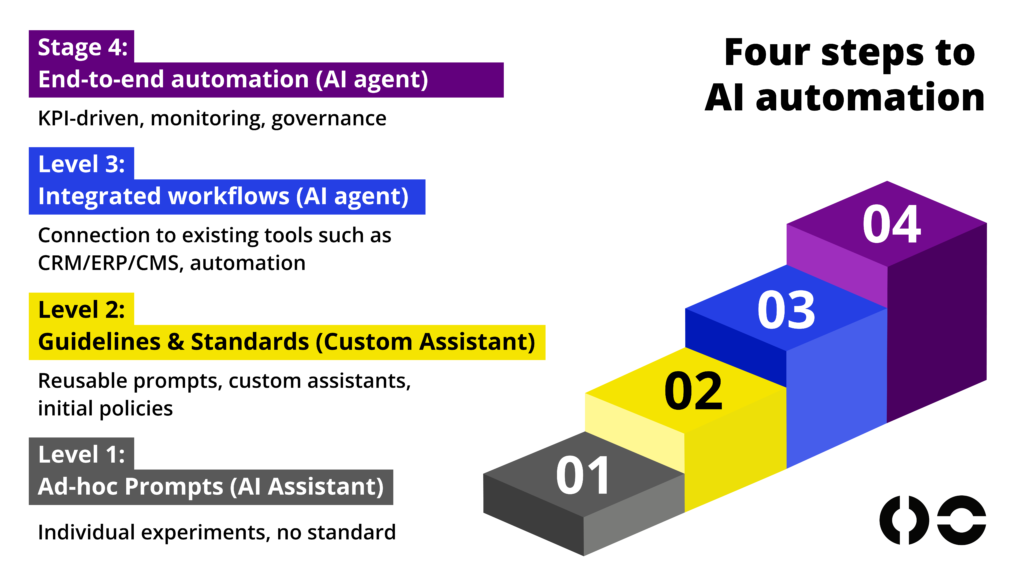
Artificial intelligence today means much more than just shortening texts or summarizing emails. While many companies are still experimenting with simple prompts, others are already entering the phase of true value creation: the deep integration of AI into business processes.
Rather than manual inputs, we are experiencing (partial) automation. Whether it’s processing customer inquiries, lead management, or complex data analyses. Of course, this requires clean interfaces and a well-thought-out architecture. But don’t worry: it sounds more complicated than it is. We support you in pragmatically and securely integrating these technologies into your existing landscape.
Why is AI a game changer for companies?
AI is not an end in itself; it realizes its benefits always in the context of a specific goal. In our projects, AI is primarily applied in three areas:
- Increase Efficiency: Automated processes save time and resources, whether in handling inquiries, content creation, or data management.
- Enhance Customer Experiences: Through personalization and intelligent recommendations, AI can help deliver tailored content at the right time.
- Make Better Decisions: AI-driven analytics enable data-based decisions to be made faster and often more accurately than traditional evaluations.
Where is AI actually used?
The areas of application are diverse, depending on the industry, target groups, and the digital maturity of the company. Here are some typical fields of application:
- Marketing and Communication: AI generates content automatically and optimizes it for channels. This applies not only to text but also to high-quality images. It analyzes customer sentiments, optimizes A/B tests, and ensures consistent brand communication across all channels.
- Customer Service: Chatbots provide high-quality answers to standard inquiries and guide users to relevant subpages. Intelligent ticket workflows prioritize and route requests automatically, while FAQs are dynamically expanded for better self-service and reduced support effort.
- Sales and CRM: AI evaluates leads (lead scoring), enriches them (nurturing), and recommends the next appropriate action. It personalizes content, timing, and channel, automating and centering around the user.
- Product Development: AI identifies trends, analyzes user needs, and helps validate new ideas. Synthetic data allows for early testing before real user data is available: quickly, with low risk, and efficiently.
- Business Intelligence: Recognize patterns, predict developments, and detect deviations early. AI makes data analysis smarter. It provides solid decision-making foundations in real-time.